Why Experienced Witches Still Return to the Basics
When you have practiced witchcraft for a long time, people sometimes assume you have moved beyond the basics.
You should already know how to ground. You should have protection figured out. Your wards should always be strong, your altar should always be beautiful, and you should never need to look up the meaning of an herb, crystal, or tarot card again.
But that is not how a real spiritual practice works.
The longer I practice witchcraft, the more I understand that we never truly outgrow the foundations. We return to them—again and again.
Not because we have failed.
Not because we have forgotten everything we learned.
We return because we have changed.
The person revisiting a foundational practice today is not the same person who first learned it years ago. We bring new experiences, new questions, and a deeper understanding of ourselves. Sometimes an idea that once seemed simple reveals an entirely different layer when we encounter it again.
“Beginner” Does Not Mean Unimportant
In witchcraft, we often call practices such as grounding, centering, cleansing, protection, and warding “the basics.” Unfortunately, the word basic can make them sound like little more than a checklist we complete before moving on to the interesting stuff.
Learn to ground. Check.
Cleanse your space. Check.
Put up a ward. Check.
Now move on to spell jars, spirit work, deity work, divination, and whatever else looks more advanced or exciting.
But foundational practices are not a beginner level that we graduate from. They are the roots that support everything else.
A musician does not stop practicing scales after learning to play songs. An athlete does not abandon the fundamentals after becoming stronger. A gardener does not decide that watering the roots is no longer necessary once the plant begins to bloom.
The foundations may not always be glamorous, but they are what make the rest of the practice sustainable.
Our Needs Change as We Change
The way I understood grounding when I first began practicing is not the way I understand it now.
At first, grounding may be something you do before or after spellwork. You might picture roots extending from your feet into the earth, hold a stone, or stand barefoot in the grass.
Years later, grounding may become the thing that helps you return to yourself after a difficult shift at work, a stressful conversation, a crowded event, or a day when your thoughts are moving faster than you can follow them.
The technique may be familiar, but your relationship with it changes.
The same is true for cleansing. Early in your practice, cleansing may mean smoke, sound, salt, or a floor wash. With time, you may begin thinking more carefully about what you are cleansing, why you are cleansing it, and whether removal is actually what the situation needs.
Sometimes the room does not need to be spiritually scrubbed clean. Sometimes it needs fresh air, sunlight, rest, laughter, or a firm boundary with the person who keeps bringing chaos through the door.
Experience does not always give us more elaborate answers. Often, it helps us ask better questions.
Returning During Times of Disconnection
Most long-term spiritual practices have seasons.
There are times when everything feels alive and meaningful. You notice the moon without checking an app. Your altar draws you toward it. Your intuition feels clear, and even the smallest ritual seems filled with purpose.
Then there are quieter times.
Life becomes busy. Work is exhausting. Relationships need attention. Your health changes. Grief arrives. The world feels too loud, or you simply do not have the energy to perform an elaborate ritual.
During those seasons, it is easy to believe you have lost your connection to your practice.
You may look at the dust on your altar or realize you cannot remember the last time you intentionally worked magic. Then guilt creeps in. You begin telling yourself that you are not dedicated enough, disciplined enough, or “witchy” enough.
That is often when returning to one small foundational practice can help.
Not a complete spiritual overhaul. Not a promise to perform a ritual every day. Just one small act.
Take three slow breaths and feel your feet against the floor.
Open a window and let stale air leave the room.
Refresh the protection at your front door.
Light a candle and sit quietly for five minutes.
Step outside and notice what the land is doing.
A quiet practice is still a practice. A simple practice is still a practice. You do not have to prove your devotion through exhaustion.
The Basics Protect Us From Spiritual Bullshit
Returning to the foundations also helps us develop discernment.
Witchcraft and spiritual spaces are full of people telling us that every uncomfortable feeling is a psychic attack, every coincidence is a sign, and every difficult person must be magically banished from our lives.
Foundational knowledge gives us a place to pause before we react.
Am I sensing something in this room, or am I overwhelmed and in need of grounding?
Does this object feel strange, or do I associate it with an unpleasant memory?
Do I need stronger protection, or do I need to set a real-world boundary?
Does my home need cleansing, or does it need sleep, fresh air, and the dishes washed?
Magic and ordinary life are not enemies. Practical action does not make a spiritual practice less meaningful. In my experience, the strongest witchcraft is often the kind that knows when to use a candle and when to make a phone call.
Repetition Is Not the Same as Stagnation
It can be frustrating to return to something you think you should have mastered already.
But repetition does not mean you are standing still.
Think about walking through the same forest during different seasons. The path may be familiar, but the forest is never exactly the same. New things are growing. Old things have fallen away. Light reaches places that were once hidden.
You are like that, too.
When you revisit grounding after surviving something difficult, you understand safety differently.
When you revisit protection after learning to set boundaries, you understand defense differently.
When you revisit cleansing after accepting your shadow, you may realize that not every uncomfortable feeling needs to be removed.
When you rebuild an altar after a period of spiritual disconnection, you may choose what feels meaningful instead of what you think an altar is supposed to contain.
The practice grows because you have grown.
The Raven’s Grimoire
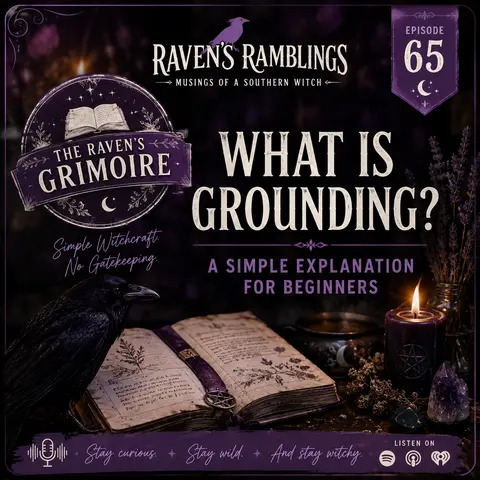
This is part of the reason I created The Raven’s Grimoire, a beginner-friendly collection within Raven’s Ramblings devoted to the foundations of witchcraft.
I wanted to create a place where we could talk about the questions people are sometimes embarrassed to ask. A place without secret rules, spiritual superiority, or the expectation that every witch must practice in the same way.
The first entries explore two important foundations:
-
EP 65: What Is Grounding? A Simple Explanation for Beginners
-
EP 66: Protection vs. Cleansing vs. Warding
These episodes are meant for new witches, but they are not only for new witches.
They are for anyone who needs to return to the roots.
You Are Not Starting Over
If your practice has felt distant lately, you do not have to rebuild everything at once.
Choose one foundation.
Ground before you reach for a spell. Cleanse one small space. Check the wards around your home. Sit at your altar without asking anything of yourself. Return to a practice that once made you feel steady.
Do not return because you believe you have failed.
Return because foundations need tending.
Even the strongest old trees continue feeding their roots.
Stay curious. Stay wild. And stay witchy.
💜 Raven